Biohazard Cleaning
Professional Decontamination and Sterilization
Expert Biohazard Removal
Biohazardous materials, including blood, bodily fluids, feces, and other biological matter, pose severe health risks due to the potential presence of blood-borne pathogens such as HIV, Hepatitis B & C, and MRSA. Standard cleaning methods and household products are not sufficient to effectively safely decontaminate these environments.
Our specialized technicians are trained to safely isolate the affected area, completely remove all biohazardous materials, and employ extensive sanitization and deodorization processes using hospital-grade chemicals. We also handle specialised cases such as forensic cleaning and hoarding restoration.
Our Process
- Assessment & Containment: We assess the scene to identify all affected areas and establish isolation zones to prevent cross-contamination.
- Safe Removal: All biohazardous materials and irrecoverable items are safely removed and disposed of according to EPA and state regulations.
- Decontamination: We apply specialized, deeply penetrating sterilization chemicals across all affected surfaces to eliminate microscopic pathogens.
- Deodorisation & Verification: We treat residual odour at its source and carry out post-remediation verification checks before confirming the area is safe.
24/7 Emergency Support
Do not attempt to clean a biohazard scene yourself. Contact our experts immediately.
Call 1800 246 367What Is Biohazard Cleaning?
Biohazard cleaning is the professional removal, decontamination and lawful disposal of biological material that can transmit disease. Trained technicians contain the affected area, strip out contaminated materials, disinfect every exposed surface with hospital-grade chemicals, and verify the result before handing the property back.
A biohazard is any biological substance that threatens human health. Blood, bodily fluids, human and animal waste, tissue and decomposition residue all fall into this category. Each of these substances can carry pathogens that survive on surfaces long after the visible mess disappears.
Ordinary cleaning does not neutralise these hazards. Household disinfectants lack the contact time and chemical strength to kill blood-borne pathogens. Domestic vacuums push contaminated particles back into the air. Mopping spreads liquid contamination across a wider area rather than removing it. Professional biohazard cleaning solves these problems with sealed containment, controlled air management, regulated chemicals and documented disposal.
Our technicians treat porous and non-porous materials differently. Non-porous surfaces such as tile, sealed concrete and stainless steel can be disinfected in place. Porous materials such as carpet, underlay, plasterboard, timber and mattresses absorb fluid and usually require removal. This distinction determines the scope, duration and cost of every job we quote.
| Service | Biohazard cleaning, decontamination and disposal |
|---|---|
| Typical duration | Three hours to two days, depending on contamination spread and porous material removal |
| Availability | 24 hours a day, seven days a week, including public holidays |
| Service area | Brisbane, Logan, Ipswich, Moreton Bay, Redlands, Gold Coast and Toowoomba |
| Discretion | Unmarked vehicles and plain uniforms on every attendance |
| Documentation | Photographic records, scope of works and waste disposal dockets supplied |
When Do You Need a Biohazard Cleaner?
You need a professional biohazard cleaner whenever biological material has contaminated a space and you cannot verify that the space is safe again. The situations below account for most of the callouts we attend across South East Queensland.
Unattended death or decomposition
Decomposition releases fluids and odour-carrying compounds that penetrate flooring, subfloors and cavities. Remediation requires structural decontamination, not surface cleaning.
Blood spills and serious injury
Industrial accidents, domestic injuries and self-harm incidents leave blood that may carry Hepatitis B, Hepatitis C or HIV. We decontaminate the scene and dispose of the waste lawfully.
Tenancy turnover and vacant properties
Property managers call us when a departing tenant leaves biological contamination. We document the scope thoroughly to support bond and insurance claims.
Hoarding and squalor
Long-term accumulation conceals animal waste, rotting food, mould and sharps. Our teams clear, sort and decontaminate the property with respect for the occupant.
Infectious disease contamination
Properties exposed to gastroenteritis outbreaks, MRSA, C. difficile or Norovirus need controlled disinfection with proven kill claims and correct dwell times.
Animal remains and faeces
Deceased pets, possums in roof cavities and bird or rodent droppings carry Leptospira, Salmonella and airborne fungal spores such as Histoplasma.
Discarded needles and sharps
Sharps present a direct needlestick risk to staff, tenants and children. We sweep the site systematically and dispose of sharps in compliant clinical waste containers.
Squalor and long-term neglect
Properties left in extreme neglect combine biological contamination, pest waste and structural damage, and need coordinated clearance and decontamination.
Why Untreated Biohazards Are Dangerous
Untreated biological contamination creates three distinct hazards: infection, airborne exposure and structural damage. Each hazard develops on its own timeline, and none of them announce themselves clearly to an untrained observer.
Blood-borne pathogens survive outside the body
Hepatitis B can remain infectious on a dry surface for several days. Hepatitis C and HIV also persist for a period after a spill dries. A person who cleans a blood spill without correct gloves, eye protection and a fitted respirator risks direct exposure through cuts, splashes and mucous membranes. Professional biohazard cleaning removes that risk by combining full personal protective equipment with disinfectants proven against these organisms.
Contamination becomes airborne
Dried biological material breaks into fine particles. Sweeping, vacuuming with a domestic machine, or simply walking through the area lifts those particles into the breathing zone. Our technicians manage airflow throughout the job so contaminated air is captured and filtered rather than pushed into adjoining rooms.
Fluids travel further than they appear to
Liquid follows gravity and capillary action. Blood and decomposition fluid move under skirting boards, along floor joists, through carpet underlay and into wall cavities. A surface that looks clean can sit directly above heavily contaminated substrate. We trace contamination to its full extent using controlled inspection and removal, because remediation that stops at the visible edge fails within weeks and the odour returns.
Odour is a symptom, not the problem
Persistent odour indicates that biological material remains somewhere in the structure. Air fresheners and odour treatments mask that signal temporarily without removing the source. We eliminate the source material first, then treat any residual odour that remains.
How We Work On Site
Effective decontamination depends on method and discipline. Our technicians follow the same working practices on every biohazard job, adapting the scope to what the scene requires.
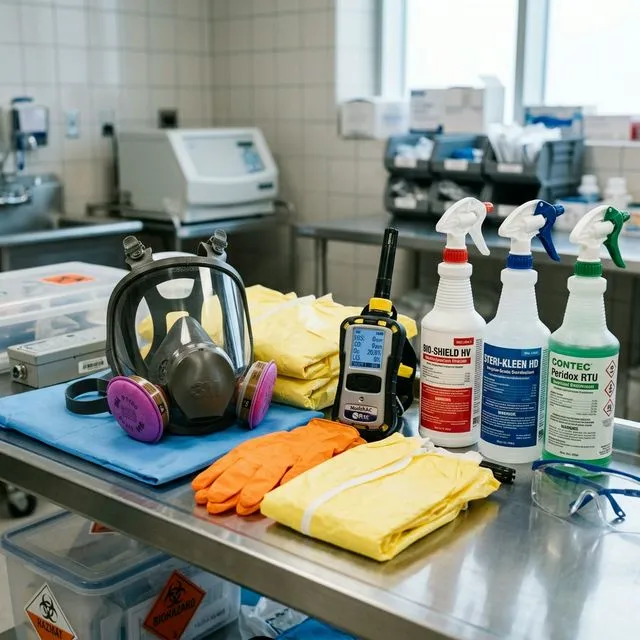
- Full protective equipment: Our technicians work in appropriate protective clothing and respiratory protection, which protects them and prevents contamination leaving the site on clothing or footwear.
- Sealed containment: We isolate the work zone from the rest of the property, which allows occupants to remain in unaffected areas where it is safe to do so.
- Controlled air management: Air inside the containment zone is captured and filtered rather than pushed into adjoining rooms, which prevents contamination migrating through the building.
- Hospital-grade disinfectants: We select products with demonstrated efficacy against blood-borne pathogens, and we observe the full contact time each product requires. Shortening dwell time is the most common reason amateur disinfection fails.
- Removal of unsalvageable materials: Porous materials that have absorbed fluid are cut out and removed rather than treated in place, because disinfectant applied to a surface does not reach what has soaked in.
- Odour treatment at the source: We eliminate the material causing an odour first, then treat any residual smell. Masking an odour without removing its source simply delays its return.
- Post-remediation verification: We carry out verification checks before signing off a job rather than relying on how a surface looks, and we record the outcome in your completion report.
Compliance and Lawful Waste Disposal
Biohazard waste cannot go into a household bin, a skip or a commercial waste stream. Queensland regulates clinical and related waste, and disposing of contaminated material incorrectly exposes a property owner or business to penalties as well as ongoing health risk.
Our work sits within the Queensland work health and safety framework, which places a duty on businesses to protect workers and other people from exposure to hazardous biological material. Contaminated waste is tracked from the property to a licensed treatment facility, and we provide the disposal documentation as part of your completion pack.
That paper trail matters more than most clients expect. Insurers ask for it. Property managers file it. Employers rely on it to demonstrate that they discharged their duty of care after a workplace incident. We issue a scope of works, dated photographs of the affected areas before and after remediation, the disinfectants and methods applied, verification test results, and waste disposal dockets.
Working with employers and body corporates
Workplace incidents carry reporting obligations that run in parallel with the cleanup. We coordinate with your work health and safety officer, attend outside trading hours where that reduces disruption, and keep our vehicles and uniforms unmarked so neighbours, staff and customers draw no conclusions about what happened.
Insurance and What Affects the Cost
Home and landlord insurance policies in Australia frequently cover biohazard, trauma and unattended death remediation. Coverage depends on your policy wording and the event that caused the contamination, so we document every job to the standard insurers expect and liaise with your insurer or loss adjuster directly when you ask us to.
We quote each job after assessing the scene, because no two contamination events are alike. Five factors drive the final figure:
- Affected area: A contained spill in a bathroom costs considerably less than contamination spread across multiple rooms.
- Porous material removal: Carpet, underlay, plasterboard and subfloor timber that has absorbed fluid must be cut out, removed and disposed of as regulated waste.
- Time elapsed: Contamination that has been present for days or weeks penetrates further into the structure and requires more extensive remediation.
- Access and building type: Upper-storey units, tight stairwells and restricted parking increase the labour required to remove waste and bring equipment in.
- Volume of regulated waste: Disposal costs scale with the quantity of contaminated material sent to a licensed facility.
We explain the scope and the cost before work begins. You will not receive a surprise invoice from us at the end of a job that was already a difficult day.
Where We Provide Biohazard Cleaning
Our team operates from Kingston and covers Brisbane and the surrounding regions of South East Queensland. We attend residential properties, rental portfolios, commercial premises, industrial sites and public spaces. Choose your region below for local response information and suburb coverage.
- Biohazard cleaning in Logan — covering Springwood, Slacks Creek, Beenleigh and Browns Plains.
- Biohazard cleaning in Ipswich — including Springfield Lakes, Goodna, Brassall and the western corridor.
- Biohazard cleaning in Moreton Bay — Redcliffe, Caboolture, North Lakes and Bribie Island.
- Biohazard cleaning in the Redlands — Cleveland, Capalaba, Victoria Point and the bay islands.
- Biohazard cleaning on the Gold Coast — Southport, Surfers Paradise, Robina and Coolangatta.
- Biohazard cleaning in Toowoomba — Highfields, Harristown, Centenary Heights and the Darling Downs.
Speak With a Biohazard Technician Now
Our phone line is answered 24 hours a day by someone who understands what you are dealing with.
Call 1800 246 367Our Professional Specialist Network
For complex restorations and high-risk environments, we coordinate with the industry's most trusted specialists to ensure structural integrity and medical-grade safety.
QBCC Licensed Builders
For structural remediations and repairs, we work in close coordination with QBCC Licensed Builders to ensure all property restorations meet strict Queensland building standards.
Occupational Hygienists
To provide absolute peace of mind, we partner with independent Occupational Hygienists (OHs) for post-remediation verification, air quality testing, and independent clearance reporting.
Biohazard Cleaning FAQ
Understanding the importance of professional decontamination and safety.
What counts as a biohazard that needs professional cleaning?
Biohazards include blood, bodily fluids, human or animal waste, tissue, decomposition residue, mould, and contamination from chemicals or infectious disease. Any of these can carry blood-borne pathogens such as Hepatitis B, Hepatitis C, and HIV, so they require trained technicians, hospital-grade disinfectants, and compliant disposal rather than ordinary cleaning.
Is it safe to clean a biohazard myself?
We strongly advise against it. Without the correct personal protective equipment, containment, and hospital-grade decontamination agents, you risk exposure to dangerous pathogens and can inadvertently spread contamination. Our trained technicians follow strict safety protocols to fully neutralise the hazard and verify the area is safe.
How long does a biohazard cleanup take?
Most residential biohazard cleanups are completed within a few hours to a full day, depending on the size of the affected area, the level of contamination, and whether porous materials need removal. We assess the scene on arrival and give you a clear, transparent timeframe before work begins.
Will my insurance cover biohazard cleaning?
In many cases, yes. Property insurance policies often cover biohazard, trauma, and unattended death remediation. We document the scene thoroughly and provide all the paperwork you need to support a claim, and we can liaise with your insurer where required.