Forensic Cleaning
Specialist Technicians for the Most Complex Biological Remediations
Advanced Decontamination Protocols
When dealing with traumatic events, crime scenes, or severe biological contamination, standard cleaning is simply not an option. Forensic cleaning requires molecular-level decontamination to ensure an environment is safe for human habitation. Our forensic cleaning experts are equipped to handle the most complex hazardous material remediations.
We work methodically to locate traces of blood-borne pathogens, bodily fluids, and infectious matter that may have seeped deeply into flooring, grout, or structural materials. Our forensic protocols are also applied to unattended death scenes and high-risk biohazard removals.
Why Choose Our Forensic Cleaners?
- Documented Verification: We don't just 'clean' - we decontaminate the environment and verify the result before signing the job off.
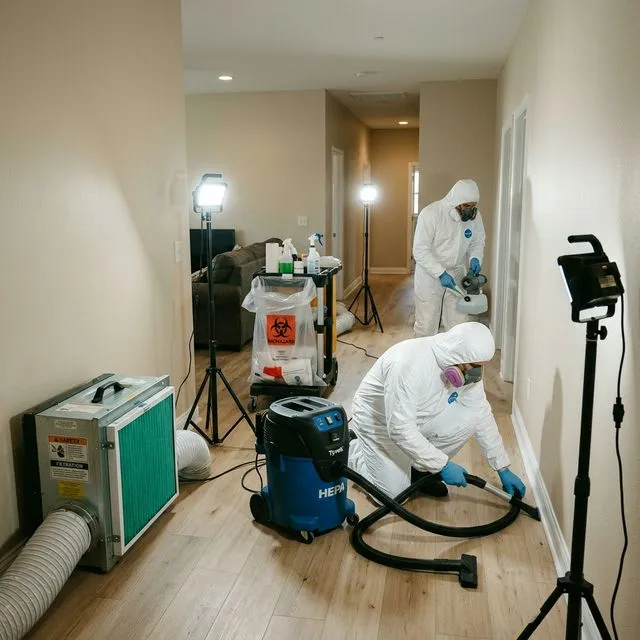
- Cross-Contamination Prevention: We establish strict quarantine zones, utilizing medical-grade PPE and containment barriers to isolate the affected area.
- Complete Remediation: If hazardous materials have penetrated subflooring or drywall, we perform structural removal and disposal to eliminate the risk permanently.
What Is Forensic Cleaning?
Forensic cleaning is the technical decontamination of a property affected by biological or chemical contamination, carried out to a verifiable standard and documented throughout. It combines scene assessment, controlled removal, hospital-grade disinfection and documented verification rather than visual inspection alone.
The term describes an approach as much as a service. A forensic clean treats the property as evidence of a problem to be measured, resolved and proven resolved. Where a general clean finishes when the surface looks acceptable, a forensic clean finishes when testing confirms the contamination is gone.
Clients engage us for this service when the contamination is complex, when a third party such as an insurer or regulator will scrutinise the result, or when the residue is chemical rather than biological. Property managers, employers, government agencies and insurers make up a large share of this work.
How it differs from crime scene cleaning
The two overlap substantially and are often used interchangeably. In practice, crime scene cleaning describes the decontamination of a scene after a violent incident or death. The forensic discipline is wider, which includes chemical residues, investigative by-products, contamination of unknown origin, and any situation where the result must be demonstrated rather than asserted. Most crime scene jobs are performed to a forensic standard, and we apply the same verification testing to both.
| Service | Forensic decontamination of biological and chemical hazards |
|---|---|
| Common clients | Insurers, property managers, employers, body corporates, government agencies and private owners |
| Verification | Post-remediation verification checks with documented pre- and post-remediation records |
| Typical duration | One to four days, depending on contamination type and property size |
| Deliverable | Scope of works, photographic record, methodology, test results and waste disposal dockets |
| Availability | 24 hours a day across Brisbane and South East Queensland |
Contamination We Remediate
The discipline covers a broader range of contamination than most people expect. These are the categories we are called to most often.
Investigative residues
Fingerprint powder, chemical developers and evidence-recovery compounds settle deeply into carpet, fabric and porous surfaces. Removal requires specific solvents rather than general detergents.
Chemical agent residue
Capsicum spray and tear gas particulate coats surfaces and enters soft furnishings and ventilation. Untreated residue continues to irritate occupants for weeks.
Clandestine drug laboratory contamination
Former manufacturing sites retain chemical residue on walls, ceilings, fittings and ventilation. Remediation follows assessment and requires specialist handling.
Biological contamination of unknown origin
Where the source or age of contamination is unclear, we assess conservatively, treat the full affected area, and verify the outcome by testing.
Infectious disease decontamination
Premises exposed to MRSA, C. difficile, Norovirus or gastroenteritis outbreaks require disinfectants with proven kill claims applied at correct dwell times.
Long-term squalor and hoarding
Accumulated waste conceals animal faeces, decomposing material, mould and sharps. We clear, decontaminate and restore in a single coordinated engagement.
Vehicle and vessel decontamination
Cars, trucks, caravans and boats affected by biological or chemical contamination need enclosed-space treatment and ventilation system attention.
Commercial and industrial incidents
Workplace contamination carries reporting obligations. We attend outside operating hours and produce documentation suitable for a work health and safety file.
Our Methodology
A forensic clean follows a defined methodology so the result can be repeated, explained and defended. We apply the same sequence to every job regardless of scale.
Scene assessment and mapping
We identify the contamination type, establish its boundaries, and map the affected zone. Inspection of subfloor and cavity spaces, together with controlled removal of floor coverings, tells us how far material has travelled. We record the pre-remediation condition photographically before touching anything.
Containment and air management
We isolate the work zone and draw air out of it under filtration. This keeps contaminated air inside the containment and allows the rest of the property to remain in use where it is safe.
Controlled removal
We remove contaminated material progressively, working from the least affected area toward the most affected to avoid dragging contamination through clean zones. Porous materials that cannot be disinfected in place are cut out and sealed for disposal.
Multi-stage disinfection
We apply a detergent stage to lift soil, then a disinfection stage held for the product's full contact time, then a neutral rinse where the surface requires it. Contact time is the stage most often skipped by non-specialists and the reason surface disinfection frequently fails.
Verification
We carry out verification checks at defined points across the remediated area and record the outcome. This replaces a subjective visual judgement with a documented check. Where an area does not pass, we re-treat it and check it again.
Reporting
We issue a report containing the scope of works, pre- and post-remediation photographs, the products and methods applied with their contact times, verification results, and the waste disposal documentation. This report is what an insurer, regulator or incoming occupier will ask to see.
Compliance, Waste and Documentation
This work generates regulated waste, and Queensland controls how that waste is handled. Contaminated material cannot enter a household bin, a skip or a general commercial waste stream.
Our work operates within the Queensland work health and safety framework, which requires businesses to protect workers and others from exposure to hazardous biological and chemical material. Every quantity of contaminated waste we remove is bagged, sealed, labelled and tracked to a licensed treatment facility, and the disposal dockets form part of your completion pack.
Why the documentation matters
The report is frequently the most valuable part of the engagement. Insurers require evidence of the scope and the method before settling a claim. Employers rely on it to demonstrate that they discharged their duty of care after a workplace incident. Property managers file it against the tenancy. Vendors and landlords use it to show an incoming occupier that the property was professionally remediated and verified. A clean without a record is difficult to prove later, and proof is usually what the client actually needs.
Discretion as a standard
We attend in unmarked vehicles and plain uniforms. We do not display signage, and our technicians do not discuss a job with neighbours, tenants or passers-by. For commercial clients we routinely attend overnight or on weekends so that staff and customers see nothing unusual.
Where We Provide Forensic Cleaning
We deliver this work across Brisbane and the surrounding South East Queensland regions from our Kingston base, attending residential, commercial, industrial and government premises.
- Logan and the southern corridor
- Ipswich and the western corridor
- Moreton Bay, Redcliffe and Caboolture
- The Redlands Coast and bay islands
- The Gold Coast, from Coomera to Coolangatta
- Toowoomba and the Darling Downs
Related services include crime scene and trauma cleaning, unattended death remediation and needle and syringe removal.
Discuss a Forensic Clean
Tell us what you are dealing with and we will explain the assessment, the method and the documentation you will receive.
Call 1800 246 367Our Professional Specialist Network
For complex restorations and high-risk environments, we coordinate with the industry's most trusted specialists to ensure structural integrity and medical-grade safety.
QBCC Licensed Builders
For structural remediations and repairs, we work in close coordination with QBCC Licensed Builders to ensure all property restorations meet strict Queensland building standards.
Occupational Hygienists
To provide absolute peace of mind, we partner with independent Occupational Hygienists (OHs) for post-remediation verification, air quality testing, and independent clearance reporting.
Forensic Cleaning FAQ
Scientific answers to your technical questions regarding forensic sterilization.
What is forensic cleaning and how does it differ from regular cleaning?
Forensic cleaning involves the specialized removal, decontamination, and sterilization of biohazardous materials from crime scenes, accidents, or unattended deaths. Unlike regular commercial or domestic cleaning, forensic cleaning in Brisbane requires advanced hospital-grade chemicals, specific safety protocols, and strict adherence to EPA guidelines to ensure microscopic blood-borne pathogens are fully eradicated.
Are your forensic cleaners trained for this work?
Our technicians are trained specifically for handling hazardous materials, bodily fluids, and infectious contamination, and we are fully insured for this category of work. Safety and compliance are our absolute top priorities.
Do you offer emergency forensic cleaning available 24/7?
Absolutely. We understand that traumatic incidents don't happen on a schedule. Our hotline is available 24 hours a day, 7 days a week for emergency support and coordination.
How do you protect our privacy during a cleanup?
Discretion is a core value of our operation. Our technicians arrive in unmarked or minimally branded vehicles, and we conduct our work quietly and efficiently to protect your privacy from neighbors, bystanders, and media.