Crime Scene & Trauma Cleaning
Discreet, Compassionate, and Thorough Scene Restoration
Restoring Safety and Peace of Mind
The aftermath of a violent crime, assault, or severe trauma is an overwhelming and deeply traumatic experience. It is crucial that the family, friends, or property owners are not burdened with the emotional and hazardous task of cleaning the scene.
Brisbane Biohazard Cleaning provides immediate, compassionate, and specialized trauma scene restoration. We adhere strictly to forensic cleaning protocols to ensure the total eradication of all blood, bodily fluids, and tissue, which may harbor dangerous communicable diseases. Our team also specializes in unattended death remediation with the same level of discretion.
Why Professional Cleaning is Necessary
- Pathogen Risk: Blood and tissue are classified as biohazards. Without hospital-grade decontamination, microscopic pathogens can remain viable for weeks or months.
- Cross-Contamination: Standard cleaning methods often merely spread the contamination over a larger area, increasing the health risk to future occupants.
- Deep Penetration: Blood can seep into subflooring, grout, and behind baseboards. Our team is trained to identify and eliminate contamination at the structural level.
- Odor Remediation: We resolve biological odours by removing the residue causing them and then treating what remains, rather than masking them.
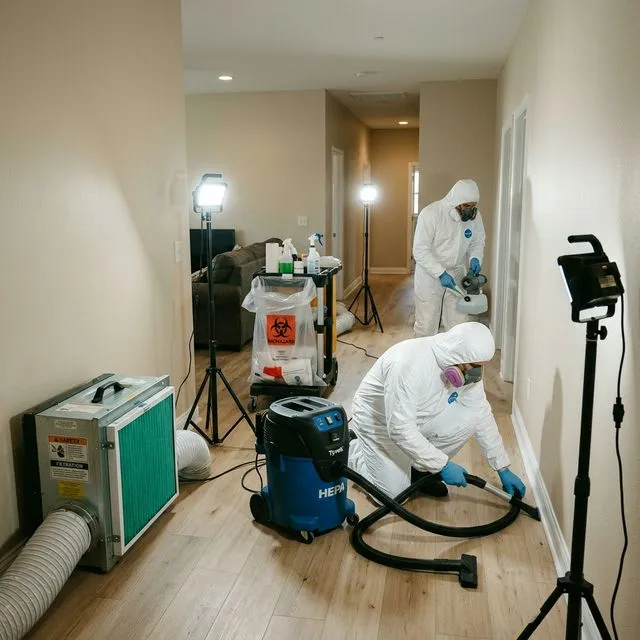
Discreet Service
We work efficiently and quietly to protect your privacy and restore the property quickly.
Call 1800 246 367What Is Crime Scene Cleaning?
Crime scene cleaning is the specialist decontamination of a property after a violent incident, death or serious injury. Technicians remove blood and biological material, disinfect every affected surface, dispose of contaminated waste through licensed channels, and restore the space so the property can be used normally again.
Police investigate a scene. Police do not clean it. Once investigators release a property, responsibility for restoring it passes to the owner, the occupier, the executor of an estate, or the managing agent. That responsibility arrives at the worst possible moment, usually with no instructions attached.
Our role begins at that point. We attend, assess the full extent of contamination, and restore the property to a safe and habitable condition. Families are never asked to be present. Many of our clients hand over a key and receive the property back complete, and that is a perfectly normal way to engage us.
Crime scene cleaning differs from ordinary cleaning in three ways. First, the contamination carries genuine infection risk, so technicians work in full protective equipment under containment. Second, the work is regulated: contaminated material becomes clinical waste and must be tracked to a licensed facility. Third, the job is not finished when the surface looks clean, because blood travels into subfloors, cavities and joins that a visual inspection never reaches.
| Service | Crime scene, trauma and accident decontamination |
|---|---|
| Who arranges it | Property owners, next of kin, executors, real estate agents, employers and insurers |
| When we can attend | As soon as police or the coroner release the scene |
| Typical duration | One to three days, depending on the affected area and structural involvement |
| Privacy | Unmarked vehicles, plain uniforms, no signage and no discussion with neighbours |
| Availability | 24 hours a day, seven days a week across South East Queensland |
Incidents We Attend
We attend any scene where biological material has contaminated a property. Every situation below is one our technicians handle regularly, and none of them requires you to explain more than you want to over the phone.
Homicide and violent assault
We restore the scene completely once investigators finish, including areas of the structure that absorbed fluid and are not visible from the surface.
Suicide and self-harm
We work discreetly and quickly, and we deal directly with a nominated family friend, solicitor or agent if the family prefers not to be involved in arrangements.
Serious accidents
Falls, machinery incidents and domestic accidents can leave significant blood contamination. We decontaminate the area and document the work for insurers and employers.
Workplace and industrial incidents
We attend outside operating hours where that limits disruption, and we supply the documentation an employer needs to close out the incident.
Vehicle and transport incidents
Cars, trucks, boats and machinery involved in a trauma incident need the same decontamination standard as a building interior.
Police searches and forced entry
Investigations leave fingerprint powder, chemical residues and structural damage. We clean the residues and make the property presentable again.
Tear gas and chemical agent residue
Chemical agents settle into soft furnishings and ventilation systems. Removal requires specific cleaning agents rather than ordinary detergents.
Rental properties and body corporate common areas
We coordinate with agents and building managers, work to their access requirements, and document everything for the owner and the insurer.
What Happens After Police Release the Scene
Families frequently tell us they had no idea what to do next. The sequence below is what typically happens, and knowing it in advance removes some of the uncertainty.
1. The scene is released
Police or the coroner confirm that investigators have finished. Only at that point can any cleaning begin, because removing material earlier can interfere with an active investigation. We will never attend a scene before it has been formally released.
2. You make one phone call
You call us and describe the situation in whatever detail you are comfortable giving. We ask a small number of practical questions: the property type, the room or rooms involved, and who holds access. We do not ask for details you find difficult to repeat.
3. We attend and assess
Our technicians arrive in unmarked vehicles. We inspect the affected area, trace how far contamination has spread by inspecting subfloor and cavity spaces, and prepare a written scope of works with a cost before we begin.
4. We contain and decontaminate
We seal the work area, manage airflow out of it, and remove all contaminated material. Porous items that have absorbed fluid are cut out and disposed of as clinical waste. Every remaining surface is disinfected with hospital-grade product at the full contact time.
5. We verify and hand back
We deodorise the space, confirm the result with post-remediation verification checks, and return the property with a complete documentation pack. Where structural repair is needed, such as replacing flooring or plasterboard, we explain exactly what is required and can coordinate that work.
Why Trauma Scenes Need Specialist Treatment
A trauma scene presents risks that ordinary cleaning cannot address. Understanding those risks explains why the work costs what it costs and takes the time it takes.
Infection risk is real and it persists
Blood can carry Hepatitis B, Hepatitis C and HIV. Hepatitis B in particular remains infectious on a dry surface for days. Anyone cleaning without a fitted respirator, eye protection, fluid-resistant coveralls and correct gloves risks exposure through cuts, splashes and mucous membranes. Our technicians are trained and equipped for exactly this exposure.
Contamination spreads beyond the visible area
Blood follows gravity and capillary action. It runs under skirting boards, through carpet backing and underlay, along floor joists, between floorboards and into wall cavities. A room can look clean while the substrate underneath remains heavily contaminated. We locate the full extent before quoting, which is why our scope sometimes includes areas that appear untouched.
Ventilation carries material through a building
Air conditioning and exhaust systems move airborne particles into rooms well away from the incident. Where a scene involves airborne contamination, we assess the ventilation system and treat it as part of the job.
The people involved are grieving
This is the difference that matters most. Our technicians are trained to work around families, to answer questions plainly, and to recover personal items carefully rather than discarding everything. If there are photographs, documents, jewellery or keepsakes in the affected area, tell us and we will do everything possible to save them.
Working With Police, Coroners and Insurers
We coordinate routinely with the other parties involved after a serious incident, which removes a considerable administrative burden from families at a time when that burden is hardest to carry.
- Queensland Police Service: We confirm the scene has been released before attending, and we never disturb a property that remains under investigation.
- The coroner's office: Where a death is reportable, the coroner may retain control of the scene for a period. We wait for formal release and keep you informed.
- Funeral directors: We work alongside funeral directors regularly and can coordinate our attendance around their arrangements.
- Insurers and loss adjusters: We prepare documentation to the standard insurers expect and liaise with your insurer directly if you authorise us to do so.
- Solicitors and executors: Where an estate is involved, we can invoice the estate and provide the itemised documentation an executor needs for the accounts.
- Real estate agents and property managers: We handle access, keys and reporting on the owner's behalf, and we keep our attendance discreet.
Insurance and cost
Home, contents and landlord policies in Australia frequently cover trauma and crime scene remediation. Coverage depends on the policy wording and the nature of the event. We quote after assessing the scene, and the figure reflects the affected area, the volume of porous material that must be removed, the time elapsed since the incident, access to the property, and the quantity of regulated waste requiring licensed disposal. We explain the scope and the cost before starting, and we do not add charges afterwards without discussing them with you first.
Where We Provide Crime Scene Cleaning
Our teams operate from Kingston and attend crime scene and trauma incidents across Brisbane and South East Queensland. Our hotline is answered around the clock, and we attend across the wider region.
- Crime scene cleaning in Logan
- Trauma and crime scene cleaning in Ipswich
- Trauma and crime scene cleaning in Moreton Bay
- Trauma and crime scene cleaning in the Redlands
- Crime scene cleaning on the Gold Coast
- Trauma and crime scene cleaning in Toowoomba
Related services include unattended death cleaning for properties where a person has died alone and been discovered some time later, and forensic cleaning for scenes involving chemical residues or complex contamination.
Call When You Are Ready
Someone answers this line at any hour. You do not need to have decided anything before you call.
Call 1800 246 367Our Professional Specialist Network
For complex restorations and high-risk environments, we coordinate with the industry's most trusted specialists to ensure structural integrity and medical-grade safety.
QBCC Licensed Builders
For structural remediations and repairs, we work in close coordination with QBCC Licensed Builders to ensure all property restorations meet strict Queensland building standards.
Occupational Hygienists
To provide absolute peace of mind, we partner with independent Occupational Hygienists (OHs) for post-remediation verification, air quality testing, and independent clearance reporting.
Crime Scene & Trauma Cleanup FAQ
Answering common questions regarding our discreet restoration services.
Do I need police clearance before crime scene cleaning can begin?
Yes. A scene can only be cleaned once the relevant authorities have released it and investigations are complete. We coordinate respectfully around police and coroner requirements, and we can be on standby so work begins the moment the scene is officially released.
Who is responsible for paying for crime scene cleanup?
Responsibility usually falls to the property owner or the next of kin, but the cost is frequently covered by home and contents or landlord insurance. We provide detailed documentation and itemised reporting to support your claim and can deal directly with your insurer.
Can you remove all traces and odours from a trauma scene?
Yes. We don't just clean visible material; we decontaminate at a microscopic level, remove unsalvageable porous materials, and eliminate odours at the source by removing the material causing them, returning the property to a safe, neutral condition.
How quickly can you attend a crime or trauma scene in Brisbane?
Our hotline operates 24/7 and, depending on your location and technician availability, we attend as soon as we can once the scene has been released. We arrive in discreet, unmarked vehicles to protect your privacy.